

Retail and In-Store Activations: How to Drive Footfall, Dwell Time and Data
Retail marketing managers have the same three-headed problem every quarter. Get people through the door. Keep them on site long enough to browse, buy, or at least remember the brand. And turn that moment on the shop floor into something the business can actually use afterwards. A folding table in the concourse and a voucher code aren't going to cut it any more.
That's where sharp retail activation ideas earn their keep. We're Social Jungle, an experiential marketing and brand activation agency based in East Kilbride, and we build brand activations for retailers, shopping centres, and pop-up campaigns across the UK. Our kit has delivered for Adidas at Battersea Power Station, at Livingston Designer Outlet, inside Braehead Shopping Centre, at BST Hyde Park, and on matchdays for Rangers FC and Celtic FC. The same principles apply whether you're filling a mall atrium or activating a flagship store.
This post is for retail marketing managers, shopping centre event teams, and brand agencies briefing in-store work. We'll cover what a retail activation should actually deliver, the formats that work best in tight retail footprints, how branded content extends your campaign online, and the data-capture mechanics that turn a one-off visit into an opted-in contact.
Jump to a section:
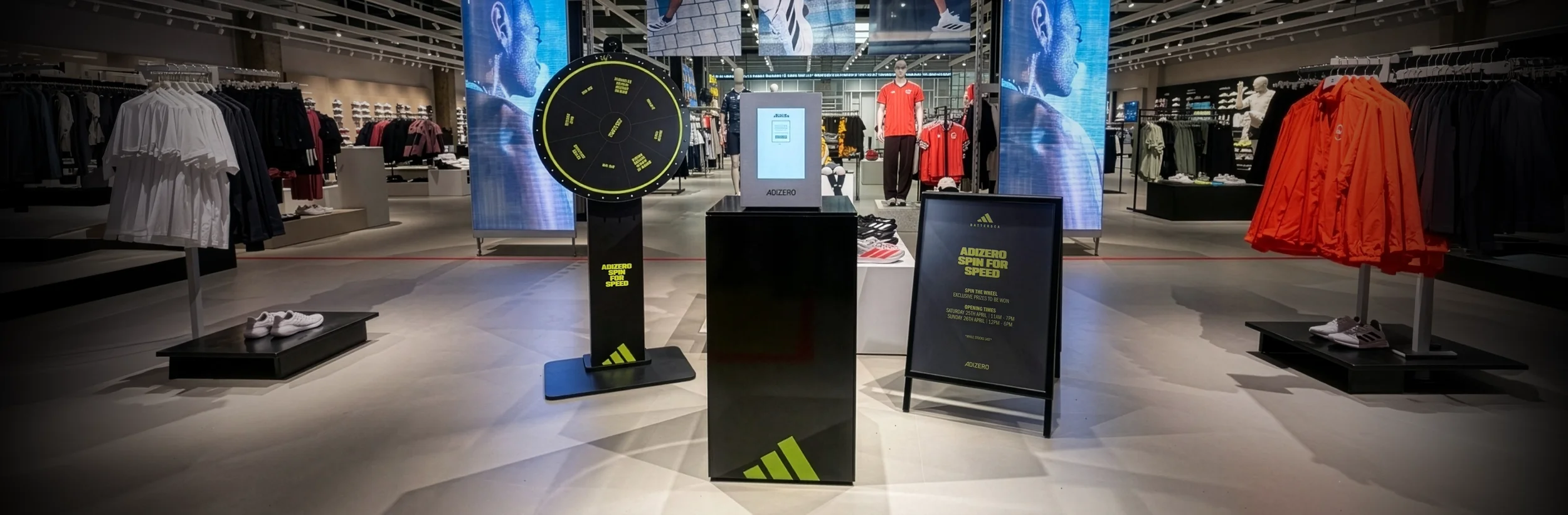
Adidas ADIZERO Spin for Speed -- an in-store brand activation by Social Jungle, bringing the thrill of the race to the shop floor.
What Do Retail Activations Actually Deliver?
Before getting into formats and kit, it's worth being clear about what a retail activation is being asked to do. In our experience, the brief comes back to the same three outcomes, and these are the criteria the activation should be judged against.
Footfall is the obvious one. A well-briefed activation pulls people off a concourse, into a store, or through the doors of a pop-up that would otherwise feel optional. The pull needs to be visible, visually strong, and understood at a glance. If a shopper has to stop and read three lines of copy to work out what's going on, you've already lost them.
Dwell time is the underrated one. Once a shopper is engaged with an activation, they're not walking past the brand messaging or the product beside them. Every additional minute raises the chance of a browse, a conversation, or a transaction. Good retail event marketing is about holding attention as much as capturing it.
Data is where the return lives. A footfall spike that disappears the moment the kit comes down is a cost. A spike that leaves you with 800 opted-in email addresses and 1,200 pieces of branded social content is a marketing asset that keeps working for months. If the activation doesn't turn visits into data, the brief has missed a trick.
Hold those three outcomes in mind for the rest of this post. Every format and mechanic below is being judged against them.
Compact, High-Throughput Activations Suited to Retail
Retail space isn't generous. You're usually working inside a shopping centre atrium, a concourse slot, a store corner, or a pop-up footprint of 3x3 metres or smaller. The activation has to earn every square metre, move guests through quickly during peak hours, and ask almost nothing of passers-by in terms of explanation. A few formats do this particularly well.
Our AI photo booth hire turns guests into themed AI portraits in under ninety seconds. It takes a tiny footprint, scales to hundreds of participants per day, and the creative output, a shareable branded image, does a lot of the marketing work for you after the activation has finished.
Traditional photo booths still punch well above their weight in a retail environment. They give a queue something to look at, the branded frames and overlays turn every print into a walking billboard, and guests hand over their details for the digital copy without a second thought.
A Spin to Win activation is the fastest way to pull a crowd in a retail setting. The wheel is visual, the mechanic is instantly readable from across an atrium, and every spin is a 30-second interaction that guests will queue for. Combine it with a small on-spot reward or a retail voucher and it turns into both a footfall driver and a sales tool.
The common thread across all three: compact footprint, high throughput, a low barrier to participation, and a branded content output the guest actively wants to share.
Branded Content as a Retail Driver
Every activation that produces a shareable output, whether that's a photo, a GIF, an AI portrait, or a 360 clip, turns the guest into a content distributor. That's the point. The guest's friends, family, and followers see the brand at the same moment the guest does, on a surface the brand didn't have to pay to access.
The mechanic is straightforward. Branded overlays, frames, logos, and campaign hashtags are baked into the asset before it leaves the booth. When the guest shares, the branding goes with it. On a busy shopping centre activation, that reach can sit two orders of magnitude above the in-venue footfall figure, which is often where the real campaign ROI comes from.
The details matter. Overlays that feel like an afterthought get cropped out the second the image hits Instagram. Get the design right and guests leave it on. It's one of the reasons we spend real time on the branded content template at the briefing stage, not on the day.
Data Capture: Turning Footfall Into a Marketing Asset
This is the section that matters most for retail marketing managers answerable to a head of CRM. A footfall figure on its own is a vanity metric. A list of opted-in contacts is something the brand can remarket to for the next 12 months.
The mechanic across most of our activations is consistent. Before the guest gets their branded photo, AI portrait, or Spin to Win prize, they enter an email address (and often SMS, birthday, or postcode) on a kiosk or tablet. The data flows straight into the brand's CRM or marketing automation platform, GDPR consent captured at the point of entry. No double handling, no paper clipboards, no day-after import.
The difference between an activation that captures data well and one that doesn't is almost always about friction. If the form takes 90 seconds and eight fields, drop-off climbs and the queue backs up. If the form takes 15 seconds and three fields, nearly everyone completes it. We default to short forms, clear consent language, and a meaningful reason to hand the data over: the photo, the GIF, the chance at a prize.
On a typical shopping centre activation running a full weekend, we'd expect 500 to 2,000 opted-in contacts depending on footfall, mechanic, and incentive. That's a database the brand owns outright. Once the kit has packed down, those contacts are still live, which is where the retail ROI really shows up.
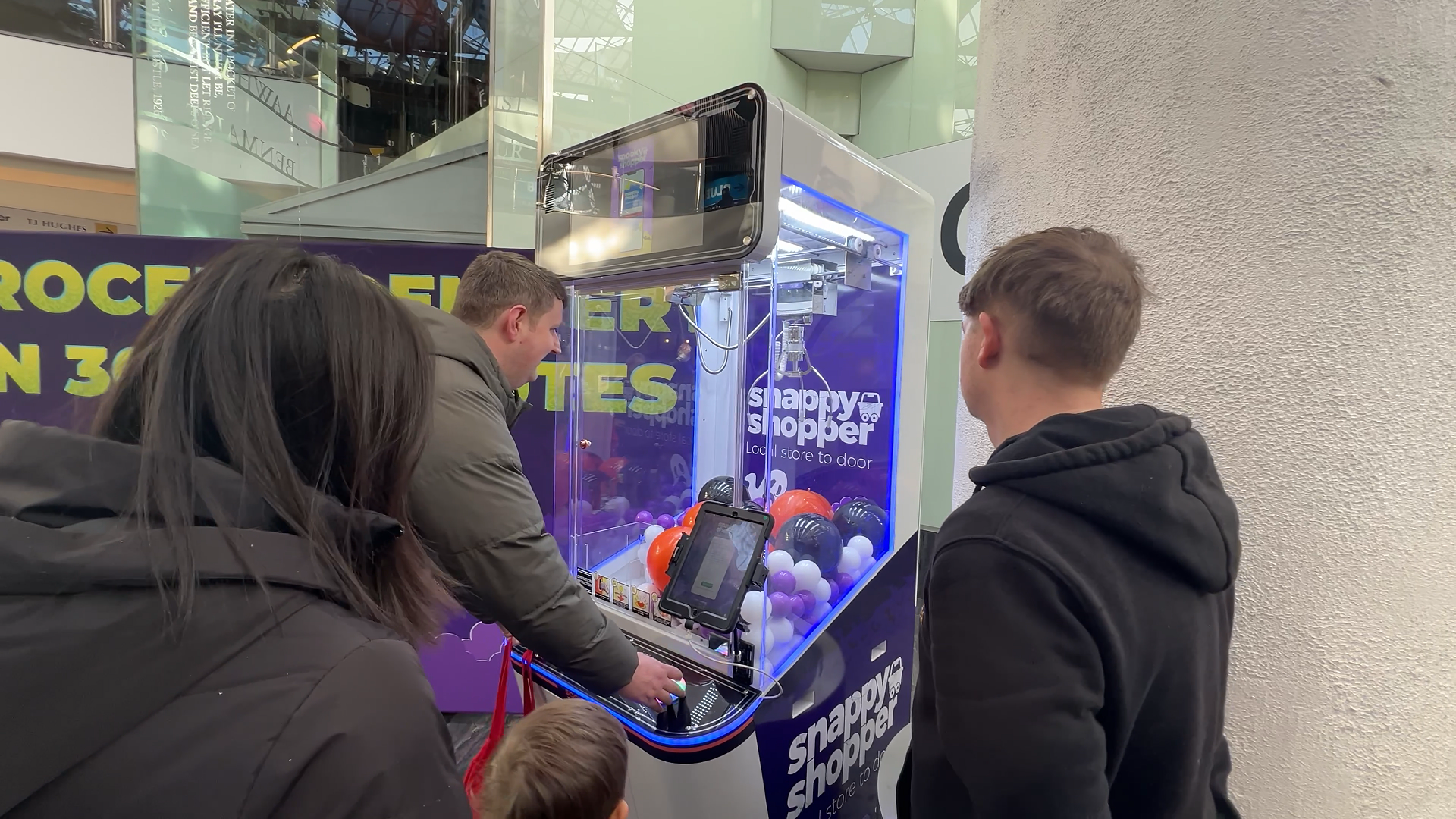
The Claw in action at a Snappy Shopper retail activation — branded wrap, tablet-enabled data capture, and a family of shoppers pulled in mid-play. Exactly the crowd-stopping effect the format is built for.
Recent Retail Activations We’ve Delivered
A handful of recent activations from the Social Jungle calendar give a sense of how these formats land in real retail environments.
Lockbox at Adidas, Battersea Power Station
We delivered a Lockbox activation in-store at the Adidas flagship inside Battersea Power Station. Lockbox is a tactile, code-based mechanic that turns a queue into a game and rewards engagement with on-spot prizes. In a retail flagship, it gives shoppers a reason to linger that has nothing to do with the product wall, and the conversion lift on guests who play and then browse is the real story.
Quest at Livingston Designer Outlet
We ran a Quest-based Easter egg hunt at Livingston, sending shoppers around the centre with branded clues, hidden assets, and a digital reward at the end. Quest works particularly well in shopping centres because it pulls dwell time across multiple stores and tenants, not just one anchor brand, which makes it a strong fit for centre marketing teams who need every retailer to feel included.
Graffiti Wall at Braehead Shopping Centre
Over Easter, our Graffiti Wall ran as a colouring-in activation at Braehead. It's a low-tech, high-joy format. Kids spend longer than you'd expect, parents share the photos, and the wall itself becomes a piece of seasonal branding the centre can dress around for the duration of the campaign.
Across all four, the same retail principles apply: a small footprint, fast throughput, a branded content output, and a data capture mechanic baked into the flow.
Planning a Retail Activation: What to Consider
A retail activation lives or dies on a handful of practical details, and the brief is stronger when these are flagged early.
Footprint comes first. Measure the actual space available, including ceiling height, nearest power point, and queue overflow. A 3x3 metre slot behaves very differently to a 5x5 one, and an atrium glass roof will rule certain formats in or out.
Power and Wi-Fi are the silent killers. Most of our kit needs a standard socket and a reasonably stable connection for data capture and social sharing. Shopping centres often have both in awkward places, and finding out on the install day isn't the moment to discover it.
Throughput planning matters when the campaign is tied to peak retail hours. If a single activation can serve 40 guests per hour and the footfall window is 4,000 people on a Saturday, the brief needs a second unit, a faster format, or a queue strategy.
Brand guidelines, overlay design, competition mechanics, and data-handling requirements all feed into the creative build. The more we know at the brief stage, the cleaner the execution on the day. Lead times for retail activations are usually two to four weeks for standard formats, longer for custom-built or fully branded sets.
So, if you're planning any sort of retail activation, get in touch and we'll talk through the space, the audience, and what's going to do the best job in it.
Frequently Asked Questions About Retail Activations
Click the ‘+’ to see the answer for each question below.
-
A retail activation is a temporary, branded experience set up inside a shop, shopping centre, or pop-up space to attract shoppers, engage them with a brand, and capture data or content. It combines physical presence, a photo booth, a Spin to Win wheel, a branded set, with a digital or social output the guest takes away.
-
Most modern photo booths, including ours, collect the guest's email or phone number at the point they receive their digital copy. The data flows straight into the brand's CRM with GDPR consent. A busy weekend in a shopping centre will typically generate 500 to 2,000 opted-in contacts the retailer can remarket to long after the activation has packed down.
-
Our AI photo booth has one of the tightest footprints we offer, needing roughly 2x2 metres plus queueing space. Spin to Win is similarly compact. Both are well suited to in-store displays, narrow concourse slots, or pop-up retail environments where a full branded set wouldn't physically fit the space available.
-
Yes, and they're often where activations work hardest. Pop-ups and temporary retail stores rely on activations to generate footfall from scratch, without the advantage of a permanent customer base. Compact, portable formats like photo booths, Spin to Win, Lockbox, and Graffiti Wall are built to install quickly and perform inside short campaign windows.
-
We work directly with retail marketing teams, shopping centre operators, and brand agencies across the UK. That usually means a scoping call, a space survey, a creative treatment matched to the campaign, then delivery on site with our own crew. We cover activations from single-day pop-ups through to multi-week campaign residencies.
Ready to Brief Your Next Retail Activation?
If you're planning a retail campaign, we'd like to hear the brief early. The earlier we know the space, the audience, and the outcome you're pushing for, the stronger the recommendation will be. Retail activation ideas work better when the creative has room to breathe, not when it's squeezed into the last fortnight of the plan.
You can get in touch with the Social Jungle team directly, or come and see the kit in person at our Experiential Playground showroom in East Kilbride. It's the fastest way to work out what will actually perform in your retail space before you commit to a format.